Thursday, March 24, 2016

Closet Inventory

In the interest of time and my sanity, I only catalogued the clothes that I wear out of the house. I have around 225 garments that fit this standard.

This consisted of:
90 tops (shirts, sweaters, cardigans)
40 dresses
20 skirts
10 pairs of shorts
8 pairs of jeans
20 pairs of shoes

Of these 225, I wear 59 articles regularly. This is approximately 26%.  40% made in china, 21% in the USA, 19% in Vietnam, and the rest were divided between Bangladesh, Sri Lanka, Philippines, India, Korea, etc. These results were mostly what I expected. I noticed that almost all of the items I purchased from thrift shops were made in the USA. These garments were older than the rest of my clothes, some possibly 20+ years old. This is probably due to the growing rates of outsourcing in the past few decades. I bought most of my clothes new, around 80-85%. Maybe 5% were gifts. Clothing from H&M was frequently made in Bangladesh, and Forever 21 from China.
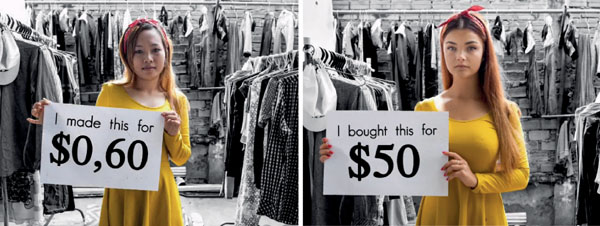


I wasn’t particularly surprised by how much I have. I knew before this that I have way too many clothes. The part that scares me is I didn’t count pajamas, lounge clothes, or accessories. I’m sure with all of those things I would have a much higher number. I am not satisfied with my results. In the past six months or so, I’ve cut back on my shopping, but years of buying way too much led to where I am now. When I saw this assignment at the beginning of the semester, I was afraid to know the results of the inventory. I’ve decided recently to do a serious closet cleanout. I have a large amount of items that I have never worn.


Most of my clothes are from fast-fashion retailers. I’ve always done a large portion of my shopping at TJ Maxx/Marshalls, and in the past five years, H&M and Forever 21. A few weeks ago I was in Marshall’s, and checked the country of origin of a lot of garments as I looked at them. They were overwhelmingly made in China. I did not end up buying any clothes that day. Being in a store now and knowing the possible background of garments has made me put more thought into the things I buy. I want to do more secondhand shopping, and start buying clothes from smaller brands that do not outsource their production. 

Monday, February 22, 2016

Pauline Newman


               Born in Lithuania to a poor Jewish family, Pauline Newman began fighting for rights at a young age. After being refused admittance to the local public school, she sought education at a Jewish all-boys school. She asked the rabbi for special permission, and he allowed her to attend Sunday school. Still, she was not allowed to study religious texts. She convinced her father to let her sit in on the classes he taught. Despite these small victories, Newman was not satisfied with the way women were treated in Judaism. This is ultimately what sparked her passion in women’s rights. After her father’s death in 1901, her family immigrated to New York City. 

               Newman worked at the Triangle Shirtwaist Company as a child. She experienced the terrible working conditions in the factory firsthand. At the age of fifteen, she joined the local Socialist Literary Club. Here, she learned about social and political theory and developed her English skills. She also organized study groups with her coworkers at the factory. Organizing these groups of women laid the foundation for the rest of her career as an activist.

               During the winter of 1907, she and a group of similar-minded women led a rent strike involving 10,000 families. This strike had a great impact, as it was the largest of its kind that the city had ever seen. After this, the Socialist Party nominated her for secretary of state of New York. Through this, she campaigned for suffrage. She participated in the Shirtwaist Maker’s strike in 1909. Afterwards, Newman was appointed as the general organizer for the International Ladies Garment Workers Union. She was the first woman to hold this position. She organized garment workers’ strikes across the country for four years after that. She also campaigned for suffrage in the Women’s Trade Union League.

               The Triangle Shirtwaist Company fire in 1911 happened only two years after Newman left the factory. She knew many of the 146 victims killed. She worked with the Joint Board of Sanitary Control to improve factory standards, and gained the respect of state legislators. While building a new branch of the WTUL, she met her partner Frieda Miller. In 1923, Newman was appointed as the educational director for the ILGWU. At this job, she promoted medical care for workers. She held the position for 60 years. She served positions in many women’s and laborers’ rights organizations. Miller and Newman were asked by the US Departments of State and labor to examine working conditions in post-WWII Germany.

               Pauline Newman spent her entire life fighting for what she believed in. She fought for women’s rights, workers’ rights, and children’s rights. Through her 99 years of life, Newman made great progress for woman workers, particularly in the garment industry. She organized strikes and helped lead organizations. The work she accomplished is truly amazing, and has made a lasting impact on the labor movement and standards in industry.

Sources

http://www.pbs.org/wgbh/americanexperience/features/biography/triangle-newman/

http://jwa.org/encyclopedia/article/newman-pauline

Sunday, January 31, 2016

Bettie Page

Bettie Page is often referred to as “Queen of the Pin-ups.” Born in Nashville Tennessee on April 22nd, 1923, she had a difficult childhood. She and he sisters were sexually abused by their father, and when her parents divorced, ended up in an orphanage. Despite all this, she graduated high school as salutatorian of her class and received a scholarship to Peabody College. Intending to be a teacher, she soon realized that her ideal career was acting. In 1943 she married her boyfriend, Billy Neal, moved to San Francisco, and got her first modeling job. Her pinup career began after her divorce from Billy, with a move to New York. In 1950, she began to model as a pinup and her popularity exploded. She worked in this field for seven years, before removing herself from the public eye in 1957, after some of her more controversial photos were linked to a court case against the photographer.

Bettie Page’s style has been emulated by many people in the past few decades. Though her fan base was originally mostly men, she is now a fashion icon to many women. Bettie Page often made her own outfits, particularly for photoshoots. Bettie Page knew how to dress for her body, and emphasized that over current trends.  She combined demure with risqué. In her daily life, Page wore swing and wiggle dresses, tight sweaters, and strappy heels. Many women seek these classing pin-up inspired fashions today. Many also don her signature “Bettie bangs.” Her lingerie photos are also imitated, in rockabilly lingerie collections.


The garments she wore in her pinup photoshoots were scandalous at the time, as they were more revealing than deemed acceptable in the 50s. Page had no problem posing nude, as she found nothing wrong with nudity. The sexually repressed society of the time fought her overt reclamation of her sexuality. She was confident and body-positive, and her revealing photoshoots expressed this. Page was a sex symbol, and in contrast to many of the pinup photos of the time, she was not portrayed as shy and submissive. The lingerie she wore in many photoshoots made her look powerful. Page's image was not the ideal passive woman of the 50s, she was in control of her sexuality and her garments helped to display this.


Bibliography
"About Bettie Page." The Official Bettie Page. Web. 31 Jan. 2016. 
"Bettie Page Biography." Bio.com. A&E Networks Television. Web. 31 Jan. 2016.
Sharyn Jackson. "Bettie Page Revealed: 6 Little-Known Facts on the Pinup Legend." Bio.com. A&E Networks Television. Web. 31 Jan. 2016.